

I’ve been following for a few years now the different reports on global AI usage assessments that, for now, are mostly led by US institutions (multiple Universities, Anthropic, OpenAI, Microsoft, Google DeepMind, OpenRouter). These global reports can tell us how AI usage is growing, which tools people prefer, and where adoption is accelerating. These data points, snapshots, and real-time data labs have are really critical to shape work as we know going forward - it helps the whole society and leaders to start having grounded conversations1. But as AI becomes part of everyday life, five questions keep appearing in conversations I have both in professional (all levels from CEOs to Junior engineers) and personal (software engineers to non-engineers) contexts to varying degrees: (a) what do you use it for? (b) which “AI”2 do you use? (c) how do you choose one? (d) do you pay for it (to how many)? and (e) how do you interact with it?
What’s here?
Instead of pretending to cover the multitude of snapshots in society’s current AI landscape in one gigantic commentary, I’ll outline my current (and evolving) framework for how I use AI to help many people with these frequent, common questions. Feel free to skip to whatever section interests you most; if you are here only to check my references, go to the end and find them organized there. Regarding the framework, I’ve intentionally kept its description tool/provider-neutral to preserve it, rather than endorse specific versions that will quickly fade as the next shining version replaces them within 1 or 2 days of this text being published.
To people very close to the technology, these questions may sound basic. However, their persistence reveals another layer of the story: AI may be going mainstream, but practical knowledge about how to use it is not spreading at the same pace3.
Usage data (check my References section) can show that someone opened a tool, returned to it, or used it for a particular task. It is less capable of showing whether that person understands the choices involved - or even knows that there are choices to make. Every report is also shaped by the tools/models it measures, the population it reaches, the data it can collect, and the interests of the institution producing it. The result is useful but incomplete: a global view of adoption that still needs local, human context.
Taken together, these questions form a practical map of AI adoption. They move from purpose - “what can this help me do?” - to selection, cost, and the many ways of accessing the technology. People are not simply asking how to write a (better) prompt. They are trying to build a working mental model of tools, capabilities, prices, and interfaces that keep changing.
Wait, before the framework, give me a TL;DR of what recent reports tell us about today's use of AI
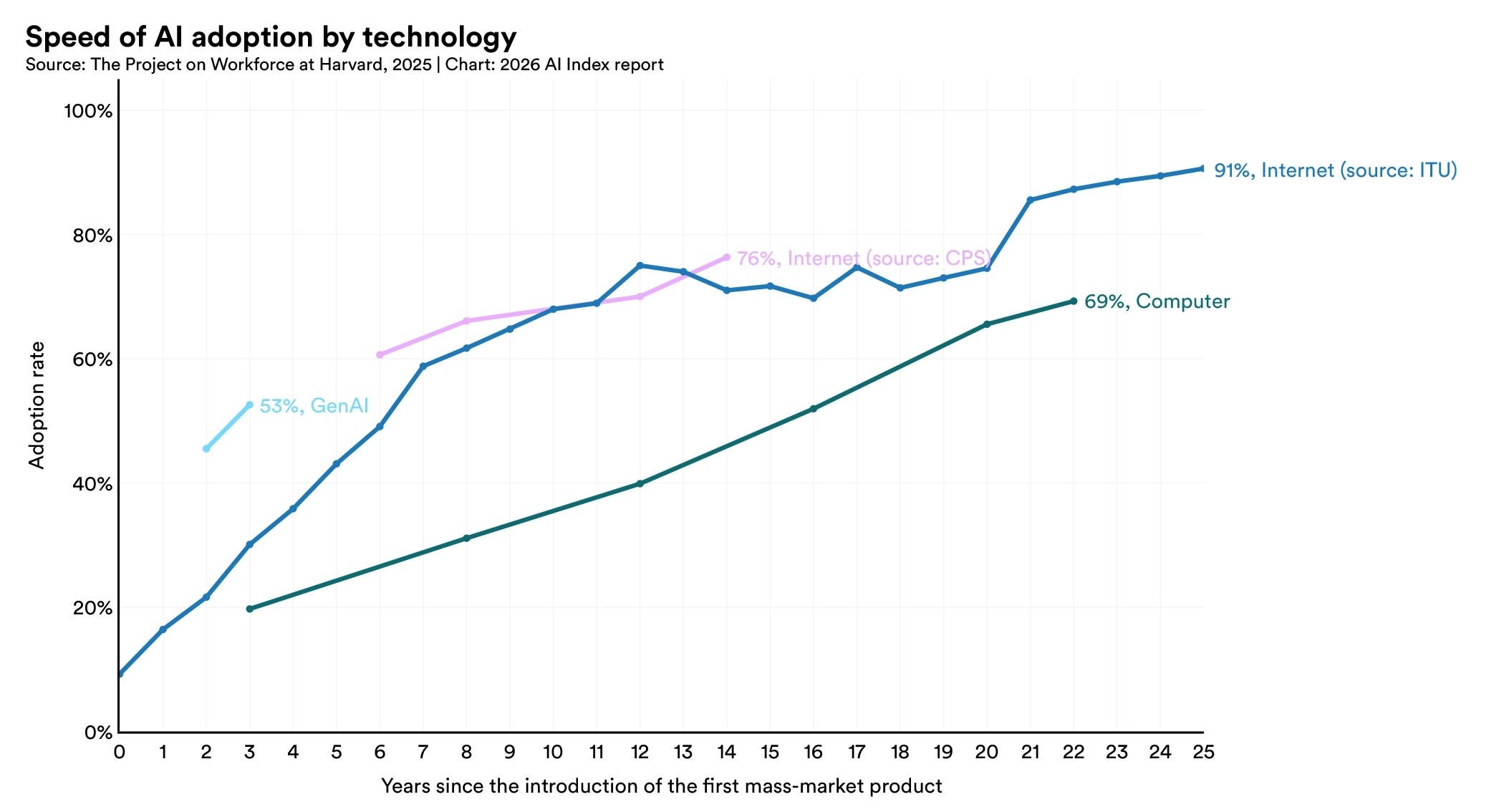
All right, but again I'm not going to examine here all the data these studies show, only give you an idea of who has been and how people have been using it. Within just three years (2023 - 2026) of its mass-market introduction, generative AI reached 53% population-level adoption globally (source: The AI Index 2026 Annual Report by Stanford University). For comparison, this is significantly faster than the adoption curves of the personal computer or the Internet. Individual platforms have scaled to historic proportions; by mid-2025, consumer platforms like ChatGPT had been adopted by roughly 10% of the world's adult population (source: How People Use ChatGPT by OpenAI, Duke University, and Harvard University), while core AI integrations, such as Google's AI search modes, serve between 900 million and over 1 billion monthly active users (MAUs) (source: Google's AI & Economy ATLAS v1.0).
Different harnesses, different realities
Across the studies different behaviors are observed. For example, despite public discourse focusing heavily on workplace productivity and displacement, Google, OpenAI, and Microsoft (source: Copilot Usage Report 2025) the vast majority of AI interactions occur in personal, unpaid domestic life while Anthropic's findings (source: Anthropic Economic Index) reveal the exact opposite pattern, with the majority of Claude interactions being driven by professional and academic activities.
Who has been and how people have been using it
Here are a few facts worth mentioning that not many people know today (everything here comes from the studies in my References section).
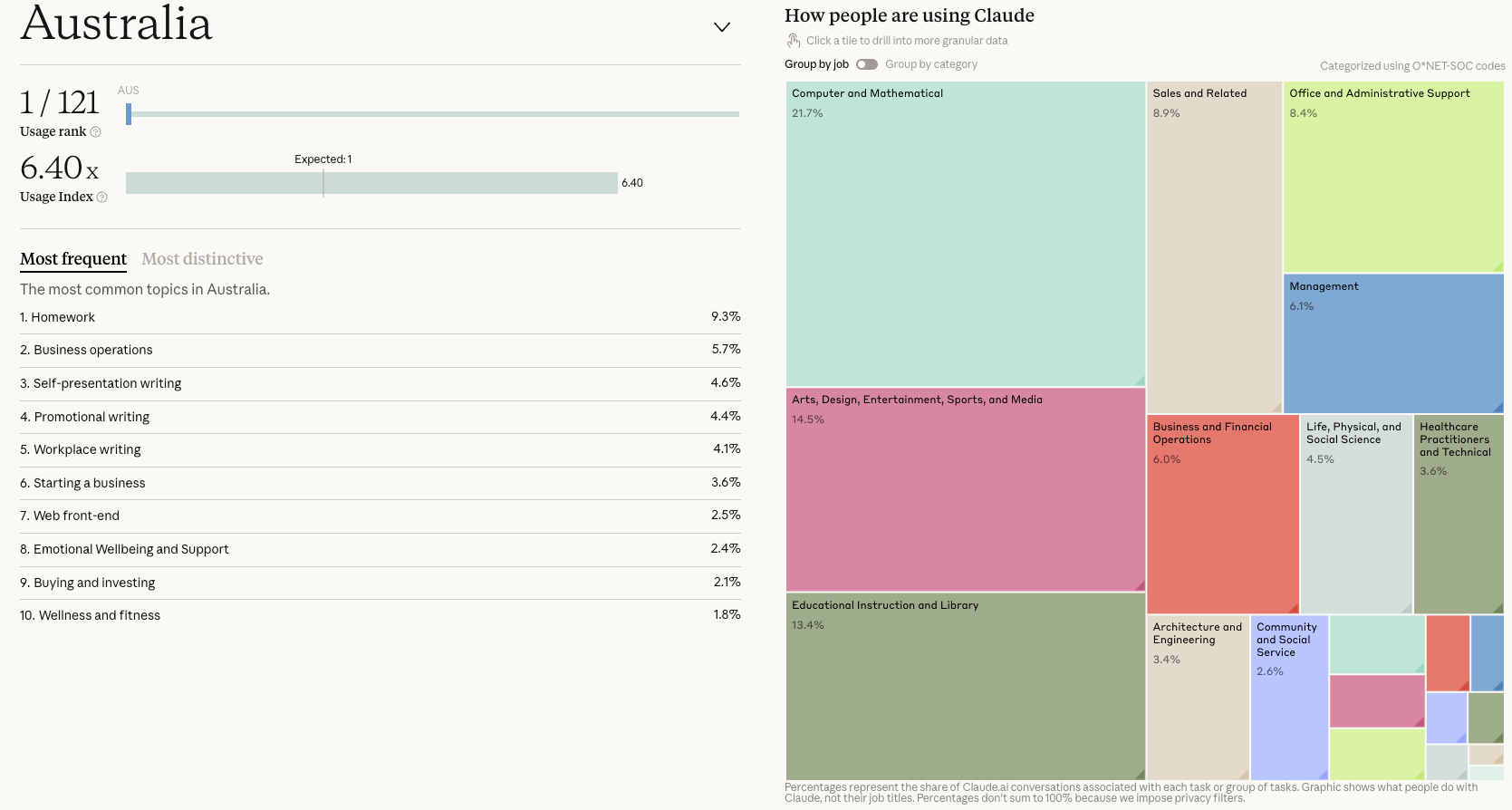
Most people would assume that, since this new technology is being developed mostly in the United States and China, these are at the top of the list of countries that use the technology most globally, but that is not the reality. According to the Anthropic Economic Index (last updated Jun 26, 2026), Australia ranks 1st globally on AI usage, followed by Singapore and Switzerland. The United States ranks 12th, and Brazil ranks 61st for comparison. Anthropic's data also breaks down the global ranks by their top 3 use cases: Work, Personal, and Coursework. Globally, Brazil ranks 1st for Work use cases, the United States ranks 1st for Personal use cases, and Tunisia ranks 1st for Coursework.
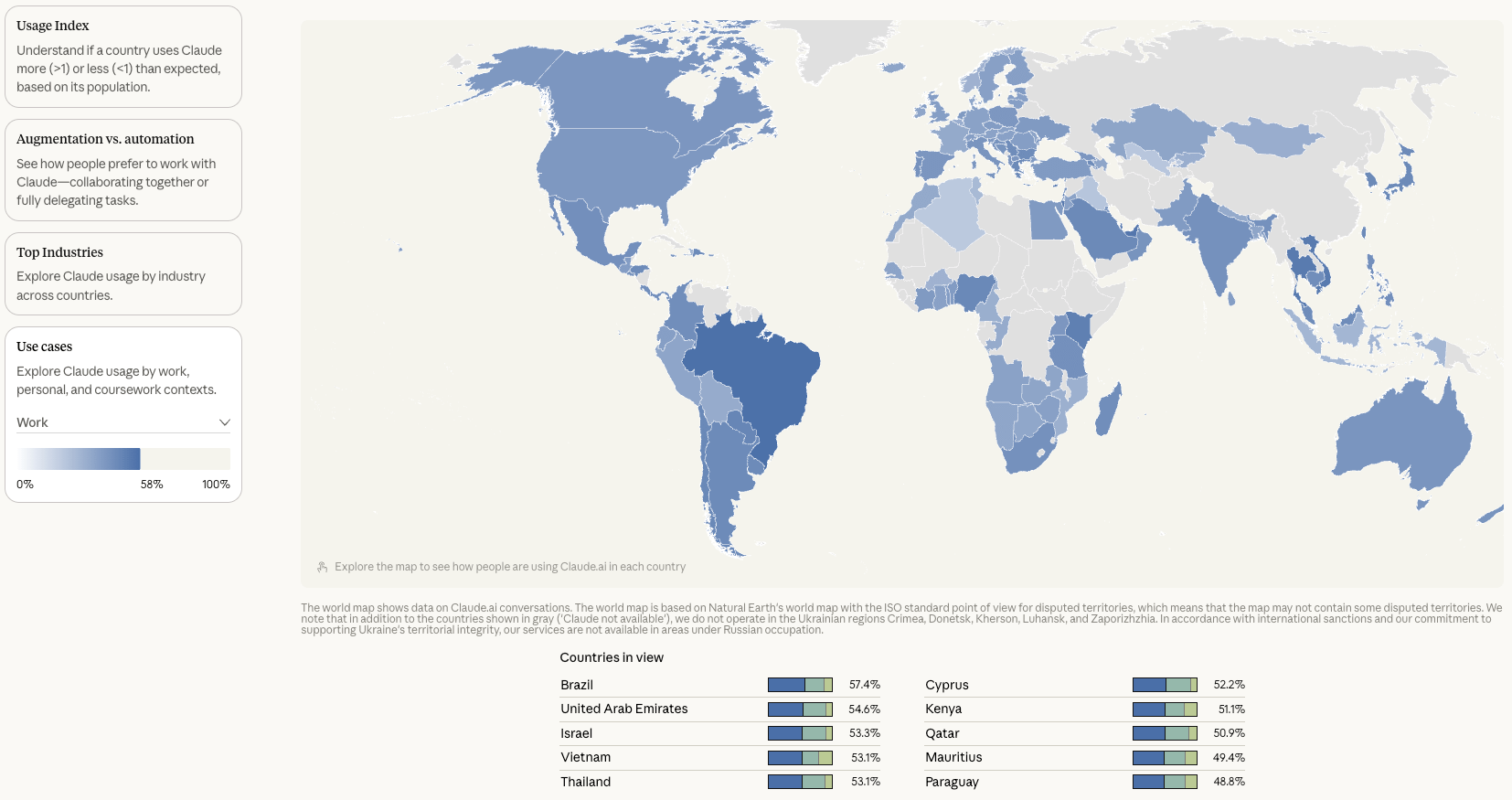
In both the Google (DeepMind ATLAS) and OpenAI (ChatGPT Usage) studies, Brazil stands out as a high-adoption, highly optimistic emerging market where AI is heavily used as a professional productivity tool. Mapped via the Google/Ipsos Multi-Country AI Survey, Brazil has one of the highest proportions of AI users who actively employ the technology to assist with their jobs. 75% of Brazilian AI users leverage AI for work tasks, placing Brazil 4th globally behind only Nigeria (91%), the UAE (83%), and India (80%).
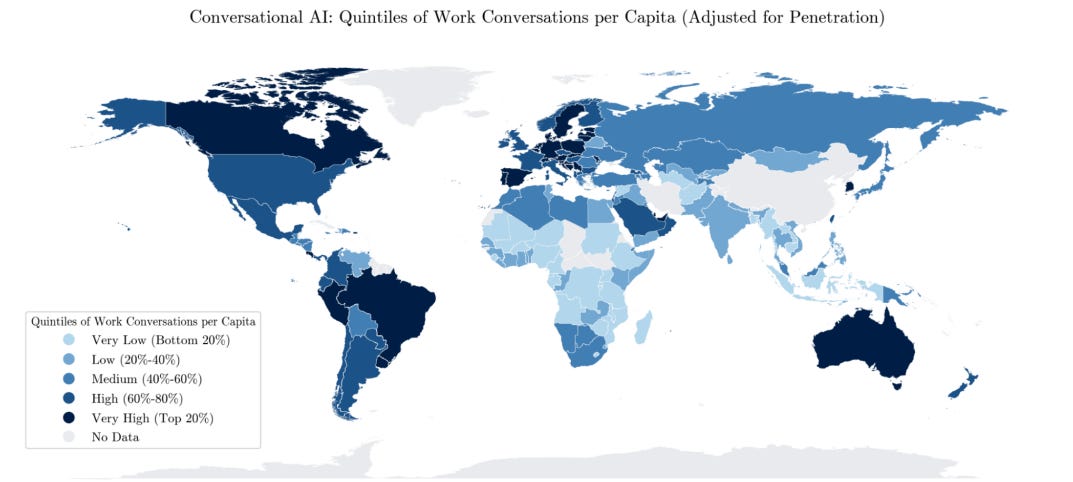
Google’s ATLAS report shows that globally 86.5% of conversational AI interactions (Gemini App and AI Mode) happen outside formal work. Socializing, Relaxing, & Leisure (26.4%) and Education (20.7%) lead this domestic share, while formal “Work & Work-Related” activities make up only 13.5% of the total. OpenAI’s ChatGPT data strongly corroborates this: non-work-related messages grew to over 70% of all consumer ChatGPT messages by June 2025 (up from 53% in June 2024).
While industry discussions focus heavily on white-collar office productivity, OpenRouter’s data reveals a massive, hidden consumer demand: over 50% of all open-source (OSS) token usage is dedicated to creative roleplay and storytelling. Mapped to granular sub-tags, 57.9% of these tokens fall under Games/Roleplaying Games, followed by writers’ resources (16.4%) and adult content (15.0%). Users gravitate toward open-weight models (like DeepSeek or Qwen) for these tasks because they can be customized and are less constrained by commercial safety moderation layers.
Programming represents the “killer professional” vertical. On OpenRouter, programming is the second-largest category overall, and Anthropic’s Claude has over 80% of its token volume dedicated strictly to Programming and Technology. Qwen shows a similar technical profile, with programming accounting for 40% to 60% of its tokens. On a global level, the Stanford AI Index reports on what Software Engineers have been seeing in real time, that AI coding agents have matured rapidly, with performance on SWE-bench Verified (a benchmark requiring models to resolve real-world GitHub issues) rising from 60% to near 100% of the human baseline in a single year. At the same time, an OpenAI study (Jun 2026) shows a gap between the features their users are using/experimenting with today and the growth potential within their user base alone. Figure 5 shows that among individual users, conversational interfaces continue to dominate: fewer than 1% of active individual users used Codex in the last 28 days.
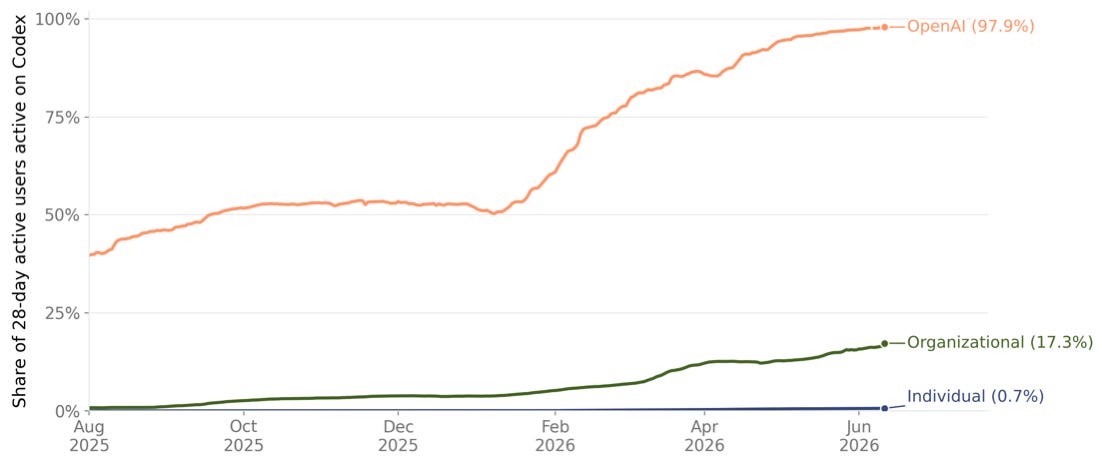
Figure 5: Codex usage relative to ChatGPT, by user population. Compares the shift to Codex across OpenAI workers, organizational users, and individual users. As artificial intelligence integrates into everyday routines, usage patterns have fractured across several distinct dimensions: device modality (desktop vs. mobile), sector domain (work vs. personal life), and interaction style (collaborative augmentation vs. autonomous automation). In contrast to human-facing chat, programmatic interfaces are designed for automated workflows. Mapped across enterprise traffic, Gemini API usage is 98.8% work-related, and Claude first-party (1P) API traffic is 74% work-related and 64% directive/automated. Enterprises utilize APIs to automate high-volume, routine back-office workflows.
Last, according to OpenAI’s ChatGPT research, work usage is intensely concentrated in a small set of Generalized Work Activities (GWAs). Mapped to the US O*NET taxonomy, nearly 81% of work-related ChatGPT messages are associated with two broad functions: (1) obtaining, documenting, and interpreting information and (2) making decisions, giving advice, solving problems, and thinking creatively.
I’ll stop here with these facts, but know there are many more to consider and explore. I invite you to review the references, check these studies yourself, and draw your own conclusions.
My current framework
Okay, now back to the five questions from the intro.
My answer to those isn’t a single task or product. I'll give you my thinking process and concrete examples of how to reason about all these. Keep in mind this is my baseline framework, which I'm adapting every day. Today’s frontier AI access is still expensive4. As its price continues to drop with advances in Computer Science, you need to adapt your operating framework as well, so keep it flexible.
(a) What do you use it for?
I'm using AI in three recurring roles:
As a thinking and review partner: to challenge project designs, test ideas, identify blind spots, review code and test coverage, find weak failure handling, improve critical communications, and turn my ideas into initial drafts.
As an execution assistant: to build proofs of concept, code systems, maintain documentation, create tickets and pull requests, apply least-privilege infrastructure patterns, investigate crashes, fix bugs, simplify business logic, consolidate duplicated implementations, and remove unreachable code.
As a research and monitoring tool: to process papers and videos, research products, explore (fuzzy, frontier) ideas, accelerate early learning, build personal tools, monitor all I need (real estate place to buy, job postings, travel fares, relevant technology events, etc).
Next, I discuss questions b and c together. By the way, this range of use is also why “Which AI do you use?” does not have a single answer.
(b) Which “AI” do you use? and (c) how do you choose one?
AI no longer means one model reached through one chat box. A provider may offer its capabilities through chat, a coding environment, voice, or features embedded in other software, while one workflow may combine products from several providers. The useful unit of choice is therefore not the brand alone, but the task and the way you need to perform it.
I choose by sizing the task before choosing the model. The method is not a ranking of products. It is a set of questions that helps me decide (i) which model to use, (ii) how deeply I need it to reason, and (iii) how the work should be executed:
Nature of the problem: How complex or rare is the task? Am I working in familiar territory or somewhere largely uncharted? Is the necessary knowledge widely available, or might it fall outside what models are likely to have learned (read more about it here)? How much factual accuracy, creativity, or novelty does the result require?
Standard and stage of the result: Am I exploring an idea, refining a direction, or producing something that must be ready for real-world use? How precise must the result be? Will I return to the work later, and how important is it to set the right trajectory from the start (or is it okay to adapt later)? How many iterations (back-and-forth) I'm okay with having in that moment?
Execution constraints: How quickly do I need an answer, and how long might the work take (seconds, minutes, hours, days, weeks, etc)? Where will it run - on a laptop, in the cloud, or on a server? What token budget is available? Would parallel work help, and if so, how many agents should participate and what roles should they play?
Level of control: How much autonomy should I grant (or am I willing to allow)? Can the system proceed directly, or does the task require a discussion first to clarify the problem and chart the path before execution?
(d) Do you pay for it?
My own setup is more involved than what most people need, but the framework does not require anyone to copy it. What matters is knowing which forms of access are available and what each choice implies. I currently use three methods:
Paid product plans: managed services that provide convenient access to a broader selection of models and, often, newer releases within the limits of a subscription.
Local open-weight models: models that can be downloaded and run on my own hardware. I currently use them for speech-to-text and proofreading, with more use cases under exploration.
Usage-based model gateways: services that provide pay-as-you-go access to multiple models. I think of this as having “tokens on tap”: I can select and combine models while seeing their usage costs more directly (i.e., their real market cost $$$ without any subsidization).
Across these forms of access, the useful comparison is not simply the monthly fee or the price per token, but the cost of completing the task. Input and output prices vary substantially (explore OpenRouter AI model comparison and Artificial Analysis Cost per Task) between models (and effort, providers), and frontier models carry a premium. The task-sizing questions above help determine whether that premium buys something the work actually requires. With hands-on practice and repeated use, you develop a practical sense of what different kinds of work cost, and that feedback improves both model selection and budget planning. The more you use it and experiment with it, the more it becomes second nature.
For someone starting to pay, my recommendation is simple: begin with the lowest tier of paid product plans that provides meaningful access, then learn how far it can carry your real tasks before upgrading5. The point is not to buy the most advanced option immediately. It is to build enough experience to recognize when a task genuinely requires more capability, speed, or capacity - and when it does not.
Paying for usage-based tokens and paying for a managed AI product are not the same thing. With a gateway, the main purchase is flexible access to different providers and models (+ advanced controls). A managed product - sometimes called a harness - surrounds a model family with an interface, tools, memory, connectors, and workflows. That convenience brings a different set of choices about which models are available and how prompts, context, uploaded information, and stored memories are handled. Price matters, but so do freedom of choice and control over data.
(e) How do you interact with it?
The interface is not merely packaging around the model; it shapes what kind of work is practical. My current use falls into four main patterns:
Local capture and processing: I use on-device speech-to-text without an account, subscription, or cloud connection. This makes voice a practical input while keeping the processing local. The same logic applies to basic text proofreading operations.
Active work across interfaces: I continue to experiment with both terminal-based interfaces (TUIs) and integrated development environments (IDEs). Each has benefits, although the experience across this space proves that it still has considerable room for improvement (UX design is currently lagging). Mobile and tablet apps also let me follow longer project sessions when I am away from my primary workspace.
Reusable skills: I maintain my own repository of global reusable instructions and workflows for different agents and managed AI products/harnesses. This removes repetitive setup (and typing), improves execution quality (as I control everything that goes in), adapts responses to my style, and makes recurring tasks easier to automate. I maintain this for my personal and professional activities.
Monitoring and background work: I use a dedicated interface to monitor agents/harnesses usage and the direction tasks are taking, as it helps me better understand the technology trajectory and costs. I also schedule automated workflows for recurring professional and personal tasks that can run in the background.
Bonus
Here's a short list of popular things I've been seeing and hearing people do, and I suggest you stop doing:
“I'm always defaulting to extra high or ultra reasoning levels for my prompts. I want to use the best for everything."
"I've saved so many prompts and skills, so much good stuff.”
“I've installed all MCPs available out there to help me automate everything with the systems I use.”
“I've created a special process for my projects to maintain memory about their work.”
“I've copied from project X all their AGENTS.md instructions to my project.”
“Everything I do with these agents has been using ‘yolo mode’, as I don't have patience to read anymore - I just need to get things done.”
There are many problems with taking these actions/stances, starting with the fact that you never learn and evolve with the technology, meaning you don’t understand exactly how things are evolving or why things work or don’t work. Aside from that, there are other issues, such as cost (of course, in case you have infinite $$$ - go for it, burn it!), security, quality control, personality, and agent/harness behavior understanding (session context management, memories, events which trigger specific actions, etc). My advice is to use, build, and think for yourself first, and then once you understand, you can definitely get inspiration from others - as you should - as everyone is going through the same phase of learning right now, including AI labs behind it all.
Closing comments
The details of my setup will change, and that is part of the point. Models, prices, interfaces, and products will keep moving. A useful framework cannot depend on a permanent list of tools, models, or harnesses. It should help people ask (critical thinking) what they want to accomplish, how much quality and control they need, what they are willing to spend, and what happens to their data. Global reports can show us adoption at scale; conversations like these show whether practical understanding is keeping up.
References
Here are the reports on global AI usage assessments I used as sources for the data analysis section of this note. The top-level groups are sorted alphabetically; no endorsements to anyone. Links without a month/year indication represent website portals with live data at the time of writing this note.
Academia (i.e., Universities):
Anthropic:
Google DeepMind:
Interconnects:
Microsoft:
OpenAI:
OpenRouter:
If you found this useful, please cite this note as:
Müller, Lucas. (Aug 2026). How have you been using and experiencing AI? lucasmuller.com. https://notes.lucasmuller.com/p/how-have-you-been-using-and-experiencing
or
@article{lucasmuller2026default,
  title   = {How have you been using and experiencing AI?},
  author  = {Müller, Lucas},
  journal = {lucasmuller.com},
  year    = {2026},
  month   = {Aug},
  url     = {https://notes.lucasmuller.com/p/how-have-you-been-using-and-experiencing}
}Read Bill Gates note from Aug 26, 2026 - An epochal shift, The turbulent AI era is here. The choices we make now are critical. Or watch his short video on YouTube.
Note that “AI” is the way people started to generalize all the choices that one has to make before using a model.
When asked why the AI industry is doing such a poor job of educating the public compared to other historical technological shifts, Sam Altman states: “No excuses. We should be doing more. I think we’ve like tried versions of this. We haven’t gotten it quite right.” - from David Senra interview Sam Altman on Building OpenAI to a Billion Users, Aug 24, 2026.
AI adoption scales almost linearly with national wealth. The Stanford AI Index and Google ATLAS find a direct positive correlation between penetration-adjusted per capita conversations and GDP per capita (PPP). In Anthropic’s global index, a 1% increase in GDP per capita is associated with a 0.7% increase in Claude usage per capita, which highlights that Claude usage is highly sensitive to a population’s wealth. Wealthier populations can easily afford premium AI subscriptions (disposable income).
The current iteration of AI subsidies won't last forever. Example: Don’t get used to cheap AI by Axios.